The Copyist's Card Is a Ticket: Copying Paintings at the Louvre
The Louvre has kept an office for copyists since 1793 and still issues permits. Here is what its own rules say about copying paintings at the Louvre.

The Louvre has kept an office for copyists since 1793 and still issues permits. Here is what its own rules say about copying paintings at the Louvre.
Have you ever stood in front of a painting you love and wished you could spend three months with it instead of three minutes? At the Louvre that is a real option, and it has been since the doors opened. The museum runs an office for copyists, it issues a card, and the card behaves like a ticket. What surprises most painters is how little of this the museum explains, and how much of what it does publish is really about forgery and fire risk.
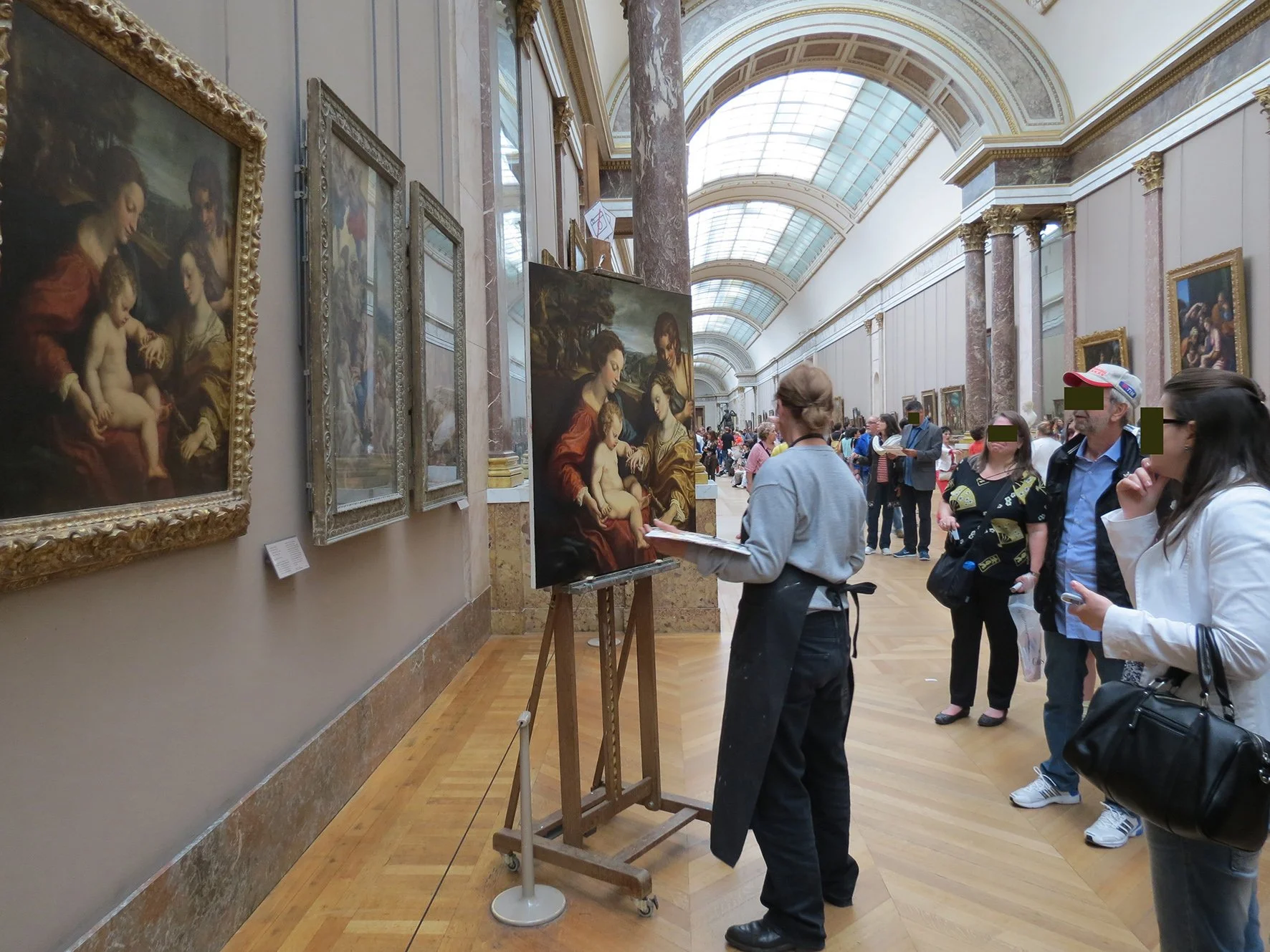
The painter in that photograph is Sigrid Avrillier, identified by the person who took it, and the picture she is copying is a Correggio. Her canvas is not the same size as the one on the wall. That is not a coincidence or a convenience, but the rule that governs everything a copyist does in this building, and the museum does not publish it anywhere.
What the Louvre's Own Rules Say About Copies
The museum's public position on copying is scattered across four articles of the visitor regulations, and the two that carry the rule itself are Articles 31 and 13. Laurence des Cars, the museum's President and Director, signed the current version of that document in Paris on 15 December 2025. Article 31 says that making copies of works in the museum requires an authorisation from the museum's President-Director, and that every request for one must first be addressed to the copyists' office, the bureau des copistes. It adds that people who hold an authorisation must comply with the particular instructions they are given, covering the protection of the works to be copied, good order, and any reproduction rights. Article 13 supplies the reason you need the card at all. Equipment for making works of art or copies may not be taken into the collections without authorisation, and it names canvases, panels, watercolours and gouache.
No fee is mentioned, no season, no application form, no description of what the office wants from you. The same document specifies the maximum dimensions of a portfolio to the centimetre. On the activity it has been licensing for over two hundred years, it gives you four scattered articles and no procedure.
Copying Paintings at the Louvre Starts With an Office You Cannot Find
The copyists' office is real, and it is close to invisible online. The museum's sitemap runs to more than three thousand pages, and it does carry copying of a sort. There is an exhibition called Copistes, and a group workshop at the Delacroix museum called Croquer, copier. Neither tells you how to get a permit. The visitor help centre, which answers questions about strollers, umbrellas and lost tickets, returns nothing at all for the word copiste, and the Louvre's 265-page annual report for 2024 never uses it once.
The fullest public account of how the office actually works is a quarter of a century old. Joseph A. Harriss described it for Smithsonian magazine in March 2001. The application was a simple form naming the date you wanted to start and the painting you meant to copy, and no samples of your work were requested. Artists who were not French attached a photocopy of their passport and a recommendation from their embassy or consulate. Permits ran three months, and the museum supplied each artist with an easel and a stool. Copying was allowed from 9am to 1.30pm, September through June, except Tuesdays, Sundays and holidays. Treat all of that as the shape of the thing rather than as this year's timetable, and write to the museum's contact service asking to be put in touch with the bureau des copistes.
Harriss also counted the season. In the 2000-2001 painting season, 150 artists made 269 copies. Nearly three in four were art students or worked in artistic professions. The rest included a psychoanalyst, a surgeon, a midwife and 13 retirees, and the largest foreign contingent was 20 Americans.
The One Real Privilege the Rules Give You
Article 5 of the same regulations is a list of things you may not bring into the Louvre, and it repays a painter's attention. Weapons and ammunition come first, then the tools you might keep in a studio drawer, and the text names them: cutters, screwdrivers, spanners, hammers, pliers and secateurs. Blunt instruments follow, with defence batons and baseball bats given as the examples, along with anything excessively heavy, bulky or foul-smelling. Incapacitating sprays are out, and so are works of art and antiquities, which is a quietly funny thing to keep out of a museum. Animals are barred apart from guide and assistance animals accompanying a person with a recognised disability, and so is any substance liable to damage the works, the buildings or the security equipment.

The copyist in that photograph is at work on Antoine-Jean Gros's equestrian portrait of Joachim Murat. The NO FLASH sign resting on the copy is hand-lettered on a loose sheet of paper.
Then comes the exemption, and it is the line that lets a copyist carry in what every other visitor gives up at the door. Duly authorised copyists are allowed to use certain of the substances banned above in order to do their work. They do it under the supervision of the surveillance staff and of the firefighters of the museum's fire prevention and safety service. The same sentence adds that they may bring in only the quantity needed for a single day's use.
One more clause is worth knowing. Article 12 lists what counts as a valid title of admission to the collections. There are five: the entry ticket, proof of free entry, a pass or badge, the copyist's card, and the group ticket. The card is not a document you show alongside a ticket. In the eyes of the regulations, it is the ticket.
What the Copyists Say About the Copy Itself
The rules that shape the object you make are published by the copyists, not by the Louvre. The Association des Copistes des Musées de France, based at Arnouville-lès-Mantes, sets them out on its own site. The copyist receives an authorisation to copy one work for three months. Your copy must be larger or smaller than the original by a fifth of its height and its width. The master's signature may not be reproduced.
The handling of the canvas is just as deliberate. A blank canvas is stamped on the front and on the back as it comes into the museum. The person in charge of copies then writes on the reverse. Onto the back of your canvas go the authorisation number, the date it entered the museum, and a reminder of the law that governs copying in French museums. When the finished copy leaves, the same person writes the date it went out. A copy may only be sold if the original is in the public domain, which in France means its author has been dead for more than seventy years.
Harriss found the same rules in force in 2001 and asked the obvious question. Maïten de Ferrier, who then headed the office that runs the copyist programme, told him forgery was not a problem the Louvre had. "If someone really wants to make a forgery, it's much simpler to work from a good color photograph in the secrecy of their own studio," she said. Read the size rule as a brief rather than a restriction and it is a demanding one. A copy that has to sit a fifth off the original in both dimensions cannot be traced or squared up casually. You are rebuilding the picture at a new scale.
If You Only Want to Sketch, the Rules Are Shorter and They Disagree
Most people reading this do not want an easel and three months. They want to sit on the floor with a sketchbook, and for that no permit exists, because none is needed. Article 31 allows freehand sketches on paper or light card up to 29.7 by 42 centimetres, which is A3, in the permanent collections and in the temporary exhibitions. The only condition attached is that you block neither the view nor the circulation of other visitors. Any drawing portfolio you bring is held to the same maximum size.

Now go to the museum's own help page on drawing in the galleries, last updated on 14 July 2024. You get a different number there: 50 by 40 centimetres. The same page bans water-based techniques, giving watercolour and oil as its examples, along with greasy pastels, felt pens and inks. Carry A3 and a dry medium and you satisfy both pages at once. Keep an eye on the bag rule as well, since Article 13 turns away any bag or portfolio larger than 55 by 35 by 20 centimetres at the door.
If you are choosing a first subject, the sculpture courts beat the painting galleries. The light is daylight, most of it stands clear of glass, and you can walk around the thing. You will also have more floor than you would ever get in the Grande Galerie.
Two Hundred Years of People Doing Exactly This
The Louvre describes itself as the last museum to hold a copyists' office, in existence since the institution opened in 1793. That line comes from the museum's page for Copistes, an exhibition it made with the Centre Pompidou-Metz, which ran from 14 June 2025 to 2 February 2026. It was curated by Donatien Grau, the Louvre's adviser for contemporary programmes, with Chiara Parisi, the director of the Centre Pompidou-Metz. About a hundred living artists were asked to imagine a copy of a work of their choice from the collections.

Winslow Homer drew that scene for the issue of Harper's Weekly dated 11 January 1868. What strikes you now is how ordinary it looks, and how many of the painters are women. Aurelia Antonini, writing for the research project Copistes et pas copieuses in January 2020, sets out why. Artists lived in the Louvre until 1848 and worked there as copyists throughout the century. Until 1855 whole days were reserved for them, and after the museum opened daily to tourists, artists were still allowed in before opening time. To get a permit you produced a letter of recommendation from the master of the studio where you trained, and you named the painting you wanted. The administration limited how long anyone could keep a sought-after picture, and it ran waiting lists for the rest.
Copying was also paid work, and there was a great deal of it about. Antonini cites the sociologist Severine Sofio's finding that nearly a third of the artists employed by the French state as copyists in the first half of the nineteenth century were women. Under the Second Empire, Antonini writes, copying was one of the few occupations in which a woman was paid what a man was paid for the same job. The state wanted copies for churches stripped by the Revolution, and portraits for its offices. Private buyers wanted versions of famous pictures, and every student needed to learn. The easels in Homer's engraving are a labour market.
Three Months of Questions About One Painting
A reproduction gives you the image and takes away everything else. It flattens the scale. The thing you have been copying from a phone may be two metres tall or the size of a paperback, and you would not know. It evens out the surface. You cannot see where the paint stands proud, where a glaze has sunk, or where an old contour has ghosted back through a change of mind. It fixes the colour under one lighting condition, while the picture on the wall shifts all morning as the daylight moves across the vault.
The other thing the room gives you is time to be curious. Three months in front of one painting produces more questions than a wall label was ever built to hold. Photograph the painting you have been standing in front of all morning and Chiaro's audio guide app for the Louvre narrates that one work, then keeps answering questions about it. For a copyist that matters more than a route, since the route is one painting long. It is also useful earlier than that, when you are deciding which painting to name on the form. Five of the works it covers play free in a browser with no download, and all five are ones the crowd already stands in front of. In 2001 Harriss reported that the Mona Lisa was one of the least copied paintings in the building. The crowds made it hard for an artist to set up an easel, and, as de Ferrier told him, its fame intimidates.
Before You Write to the Bureau
What you can know in advance is small and worth having straight. A copy needs an authorisation from the museum's director, and the request goes to the copyists' office. The card you get back is your admission. Your solvents are legal, in one day's quantity, under supervision. Your canvas will be stamped going in and dated going out, it has to be a fifth larger or a fifth smaller than the original in both directions, and the signature stays with the master.
The fee, the current season, the days of the week and the wait are not published by the Louvre, so you will learn them from the office. Two hundred and thirty years into the programme, that is still the only way to find out, and it makes for a very short letter.
Frequently Asked Questions
Q1. Do you need a permit to draw at the Louvre?
A: No, freehand sketching on paper or light card needs no permission in the collections or the temporary exhibitions.
Q2. How big can your sketchbook be at the Louvre?
A: The visitor regulations say 29.7 by 42 centimetres for paper and portfolio; the museum's help page says 50 by 40, so carry A3.
Q3. Can you use paint in the Louvre galleries?
A: Only with an authorisation, since Article 13 keeps canvases, panels, watercolours and gouache out of the collections without one.
Q4. How long does a Louvre copyist's permit last?
A: Three months for one work, according to both the Association des Copistes des Musées de France and Smithsonian magazine's 2001 account.
Q5. Why must a copy be a different size from the original?
A: A copy a fifth larger or smaller, with the master's signature left off, cannot easily be passed off as the original.
Image credits
Image 1: Sigrid Avrillier copying at the musée du Louvre, by Tigri432, Wikimedia Commons, licence CC BY-SA 4.0
Image 2: a copyist at work in the Louvre, by Leandro Neumann Ciuffo, Wikimedia Commons, licence CC BY 2.0
Image 3: a visitor drawing in the Louvre, by Jean-François Gornet, Wikimedia Commons, licence CC BY-SA 2.0
Image 4: Art-Students and Copyists in the Louvre Gallery, Paris, by Winslow Homer, public domain by age, Metropolitan Museum of Art scan released CC0 via Wikimedia Commons
Stay up to date with our latest ideas!